Get a FREE marketing audit and discover what's holding your practice back from reaching its full potential.
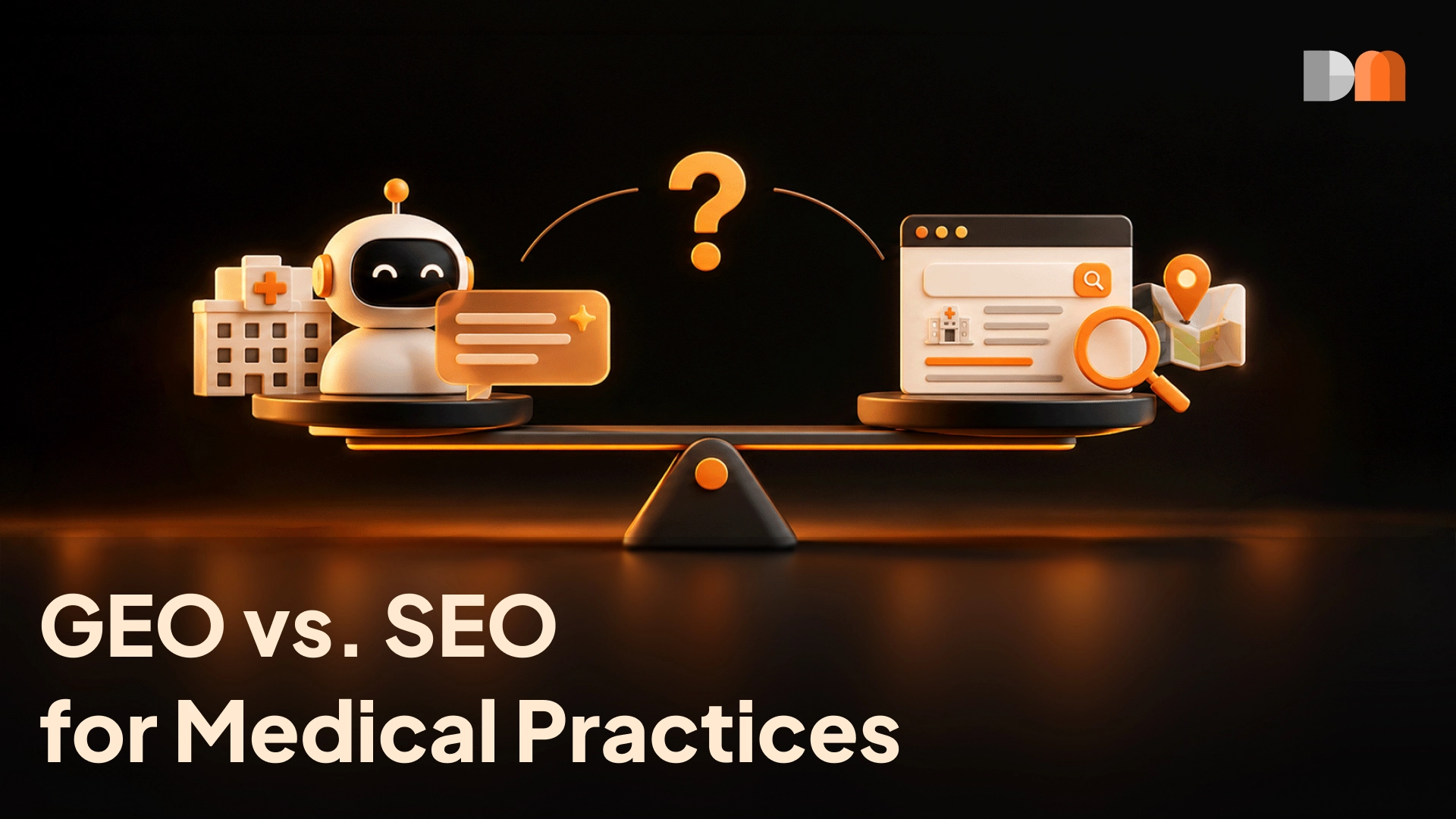
Medical practice marketing has shifted dramatically over the last decade. For years, the path to patient acquisition was straightforward: optimize a website for search engines, verify a local business profile, and wait for patients to click through the search results. Today, however, patient search behavior is fundamentally changing. Instead of scrolling through ten blue links on a traditional search page, patients increasingly rely on artificial intelligence tools such as Google’s AI Overviews, ChatGPT, Claude, Perplexity, and Apple Intelligence to ask detailed health questions and receive synthesized, conversational answers.
According to peer-reviewed public health data cataloged by the National Library of Medicine, up to 80% of adults routinely turn to the internet for health and medical information. Their rapid adoption of artificial intelligence tools is fundamentally transforming how they discover, evaluate, and choose healthcare providers. Building systemic clinical trust, increasing practice visibility, and securing an authentic digital reputation across every touchpoint a patient encounters is crucial. This helps evaluate Generative Engine Optimization (GEO) vs. (SEO) Search Engine Optimization for healthcare marketing.
Many physicians view marketing purely through the narrow lens of lead generation or appointment bookings. While maintaining a steady patient volume is vital, treating marketing merely as a transactional tool overlooks its strategic value. Healthcare marketing serves as the foundation for your practice’s long-term enterprise value:
When a clinic approaches marketing comprehensively, the technology used to drive visibility becomes part of an operational framework. Understanding how both healthcare SEO and GEO function is essential to building an enduring healthcare practice.
Traditional Search Engine Optimization (SEO) involves structuring your medical practice’s website, digital listings, and clinical content so search engines like Google and Bing can crawl, index, and rank your pages near the top of organic search results. When patients type queries such as "pediatric clinic near me" or "symptoms of severe asthma," traditional search engines use complex algorithms to analyze thousands of web pages. They rank these pages based on site architecture, keyword relevance, backlinks, and domain authority.
For healthcare providers, healthcare SEO helps your clinic rank prominently in standard organic listings and local map packs when nearby patients search for your specific services. Traditional healthcare SEO focuses on earning organic website traffic by matching specific user search terms to relevant, authoritative web pages.
Generative Engine Optimization (GEO) focuses on optimizing your practice’s content and reputation so that large language models (LLMs) and AI-driven search engines cite, mention, and recommend your practice in synthesized, generative answers. Instead of presenting users with a list of external links to explore, generative search engines synthesize multi-source data into a direct, conversational response.
For instance, if a patient asks:
"Who is the top-rated pediatric specialist in Fresno for childhood asthma, and what should I expect at the first consultation?"
A generative engine doesn’t just show links. It reads across medical directories, review platforms, clinical publications, and provider websites to generate an integrated paragraph. This paragraph answers the question directly, often recommending two or three specific clinics by name. The emerging discipline of Generative Engine Optimization in healthcare shifts the digital objective. Adopting healthcare GEO means you no longer just optimize for search algorithms to rank a page link; you train AI models to treat your providers as credible medical authorities worth citing..
To understand how these disciplines operate alongside each other, consider the fundamental mechanics that differentiate standard search optimization from generative visibility.
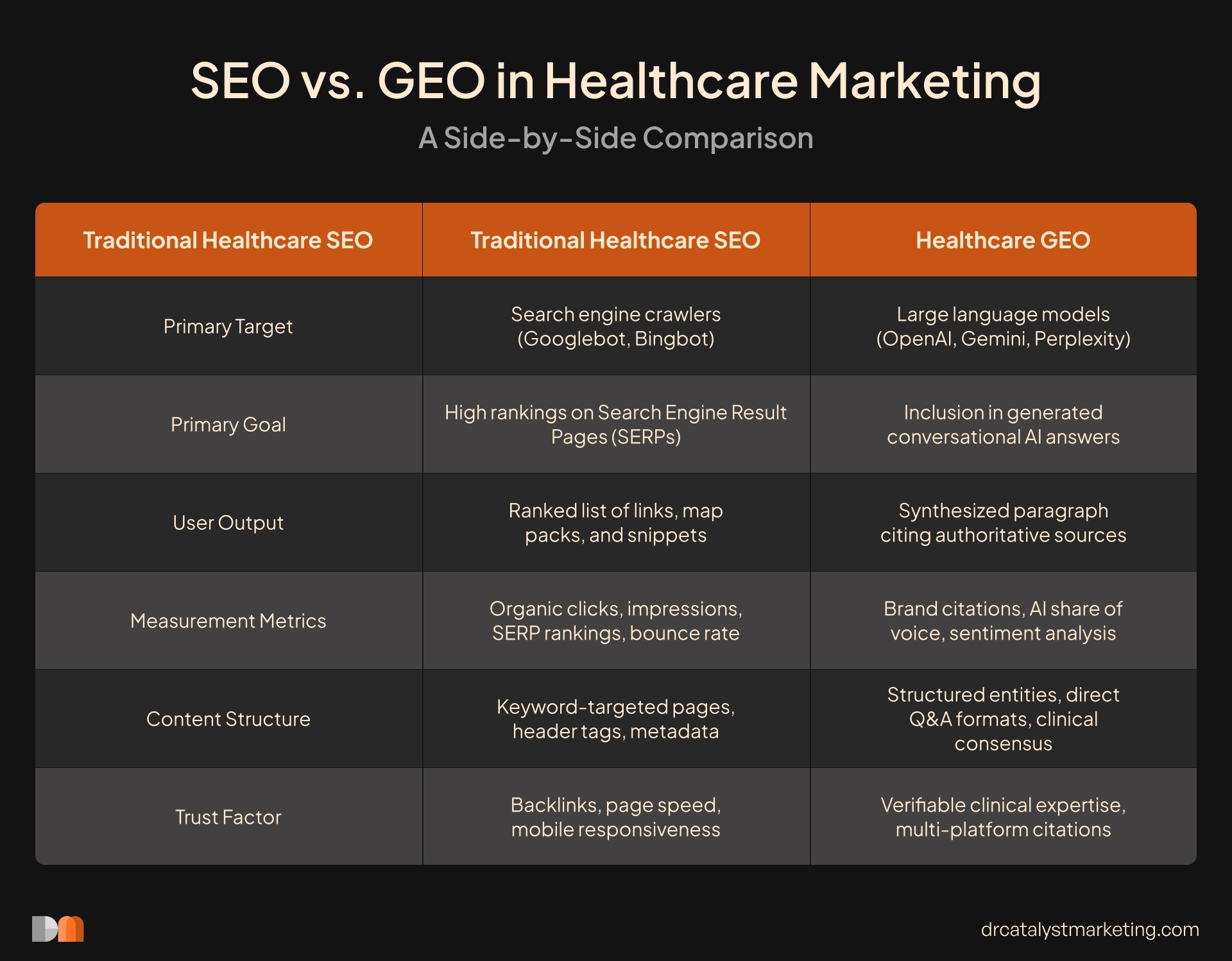
While traditional healthcare SEO drives website clicks, healthcare GEO focuses on establishing brand recall and authoritative inclusion within generative AI answers.
Understanding GEO for healthcare marketing is becoming vital because the rise of generative engines represents a permanent change in how patients access clinical information:
A growing percentage of search engine interactions now resolve without the patient ever clicking an external website link. Patients read the AI-generated overview at the top of the search screen and decide immediately. If your clinic isn't cited directly in that generative summary, your practice remains effectively invisible to those patients.
Patients rarely search using isolated keywords like "knee pain doctor." Instead, they enter nuanced, conversational questions: "I have an ACL injury from soccer and need a sports medicine doctor who uses non-surgical biologics." Generative search engines parse this complex intent and recommend practices whose published digital content demonstrates precise clinical experience in those sub-disciplines.
Healthcare decisions carry high stakes. When an AI tool like ChatGPT or Google AI Overviews summarizes an answer and specifically references your practice’s medical director as an authority on that topic, the patient views that recommendation as an objective endorsement.
This mirrors the technological modernization happening across clinic operations. Just as modern clinical operations require moving away from paper records, modern healthcare marketing requires evolving beyond basic keyword targeting to embrace multi-platform generative authority.
It is a mistake to view GEO as a replacement for SEO. Instead, strong traditional SEO is the prerequisite foundation for generative optimization. Large language models do not invent practice recommendations out of thin air. They scan, crawl, and synthesize the authoritative content that traditional search engines have already indexed. Without clean technical SEO, structured sitemaps, fast page load speeds, and strong domain authority, an AI engine will never encounter or trust your practice data in the first place.
Consider how these two strategies interconnect across a modern marketing campaign:
Effective multi-channel digital visibility mirrors cohesive operational integration. Digital marketing should not operate in silos. Traditional healthcare SEO and generative AI discovery reinforce each other, building a resilient online presence. Understanding how machine learning is reshaping the top of the patient funnel is vital for medical directors. Practices interested in this dynamic can explore our insights on AI lead generation to understand how AI-driven inquiry routing is transforming patient engagement.
Achieving balanced visibility across both traditional search engines and AI generative models requires a coordinated, dual-track approach.
Traditional SEO pages often group fragmented paragraphs around target keywords. To optimize for generative engines, structure your pages with direct, concise question-and-answer formats. Use descriptive <h2> headers framing common medical concerns. Follow each header immediately with a clear, 40- to 60-word clinical answer before expanding into deeper context. Generative models favor this layout for citation extraction.
Google's search quality guidelines place healthcare websites under the strict umbrella of Your Money or Your Life (YMYL). For both traditional and generative engines, content authority matters.
Search engines and LLMs process clinical relationships more efficiently with structured data. Implement schema markup on your website, including:
This explicit metadata lets AI engines identify your physicians, services, physical locations, and insurance acceptances without ambiguity.
Surface-level articles designed solely to rank for search terms no longer perform well. Developing comprehensive, clinically accurate educational material establishes lasting digital authority. To review effective strategies for provider-led education, read our complete guide on healthcare content marketing.
Generative engines crawl beyond your primary domain name. They review physician directories (such as WebMD, Healthgrades, and Doximity), Google Business profiles, state licensing boards, and local community news. Inconsistent clinic names, outdated phone numbers, or mismatched suite addresses confuse AI data models, reducing the likelihood that your practice will be cited in recommendations.
When medical practice managers evaluate GEO for healthcare marketing, they often ask: Should we pivot our budget away from SEO and put everything into GEO? The answer is neither one in isolation. A medical practice should focus on both. Treating these disciplines as competitors misunderstands patient behavior:
Optimizing for one while ignoring the other creates a blind spot in your practice's visibility. Partnering with experienced medical SEO agencies ensures your practice maintains traditional local search visibility while building the structured, authoritative content required for generative AI inclusion. Furthermore, medical practice leaders must recognize that search visibility is an ongoing operational commitment, not an overnight fix. To understand the milestones in search optimization, review our realistic guide to the medical SEO timeline.
The conversation around GEO vs. SEO for healthcare marketing is about recognizing that patient discovery has evolved into a multi-layered ecosystem. Patients use traditional search engines to confirm office hours, check travel times, and find immediate local care. At the same time, they use generative AI platforms to explore complex diagnoses, evaluate treatment alternatives, and choose trusted specialists. By approaching your marketing holistically, combining technical search visibility, physician-led education, structured digital authority, and patient-focused communication, your clinic builds a durable digital presence. This type of visibility thrives across traditional search results and emerging AI platforms alike.
At DrCatalyst Marketing, we know healthcare marketing is never one-size-fits-all. With 12+ years of experience, a 95% client retention rate, and partnerships with 200+ practices across 40+ medical specialties, we provide the full-spectrum infrastructure clinics need to thrive. This includes healthcare SEO, local map domination, generative AI search optimization, custom high-converting websites, targeted social media, and more. We build ethical, data-driven strategies that expand your practice’s authority and compound it over time.
Every specialty has its own patient journey. We know the difference between how someone searches for a fertility clinic and how they find urgent care.