Get a FREE marketing audit and discover what's holding your practice back from reaching its full potential.

Most practice owners ask this question about three weeks in. Nothing has moved on the phones. The website looks slightly different. Somebody has emailed a report with a green arrow on it. So when does this actually start working? The honest answer of four months to a year tends to disappoint people, depending on where you are starting from. That range is the spread between a practice with a healthy website in a small town and one rebuilding from scratch in a crowded city.
It helps to understand what you are waiting for. When Pew Research Center asked Americans what they want from a health information source, 75% said it was highly important that the source has medical training, and 72% wanted the information to be easy to understand. Those two demands pull in opposite directions, and a page that satisfies both takes time to build. That is the part most timelines leave out. SEO for medical practices moves at the speed it does because of the standard your reader is holding you to.
SEO stands for search engine optimization, which is a complicated name for a simple goal. It serves the purpose for when someone in your area searches for the care you provide, your practice appears near the top of what Google shows them. There are three moving parts in this-
The same pages a prospective patient reads are the pages a referring physician skims before deciding whether to send someone your way. They are what a candidate reads before accepting your job offer, and an unfilled provider role usually costs a practice more in a month than its entire marketing budget. A hospital system, payer, or partner organization assessing you will look you up before the first meeting. So will a patient who already has an appointment and wants to know what to expect, which usually leads to a better-prepared consultation and fewer no-shows.
Then there is your own name. For most practices, the most common search is the practice name itself, and what comes back is a mix of listings, reviews, old directory entries, and pages nobody at the practice chose or approved. Search work is how you take control of that page, which matters as much for patients you already have as for the ones you do not.
Good pages also quietly reduce work. Every question your front desk answers twenty times a week about parking, insurance, referral requirements, or what happens at a first visit is a question a clear page can answer before the phone rings. A page you publish this quarter can still be bringing in patients three years from now with no further spend.
Healthcare gets treated differently on purpose. Google's published guidance says its systems give extra weight to pages that show experience, expertise, authority, and trustworthiness when the subject could seriously affect someone's health, money, or safety. Marketers shorten that mouthful to E-E-A-T, and Google files health topics under what it calls ‘Your Money or Your Life.’ In plain terms, a page about recovering from knee replacement has to clear a much higher bar than a page selling patio furniture, and that is deliberate.
So a medical SEO strategy built for this work looks different from a generic one. Content carries a named clinician rather than going out anonymously. Someone with credentials reviews it before it is published. Sources point to research and official guidance. It is the substance Google is weighing, and it is also why clinical content takes longer to produce.
A second consequence is worth planning around because every page needs clinical review. A practice that cannot free up roughly fifteen minutes of physician time a month will move slower than one that can, whichever agency it hires. Your calendar is part of the timeline. We have written more about what separates firms that understand this from firms that have only read about it in our guide to medical SEO strategy.
Google does not promise a timeline, and nobody else should either. Its own SEO starter guide puts it plainly: "Some changes might take effect in a few hours, others could take several months." That said, the medical SEO timeline follows a reasonably predictable shape.
Repairs and housekeeping. This includes slow-loading pages, broken links, duplicate pages, settings that accidentally told Google to skip parts of your site, and a proper cleanup of your Google Business Profile. This phase moves fastest because you are usually correcting things that were actively working against you. Practices with neglected listings often see their position in the map box shift within a month.
New pages start publishing, and Google starts finding them. Two words will appear on every report you receive. Impressions mean how often your page showed up in somebody's search results. Clicks mean how often somebody actually opened it. Impressions rise first, clicks follow, and phone calls follow those. That lag is completely normal, and it is exactly the stretch where practices lose their nerve. The pages that land first usually have very specific content, like "IVF success rates after 40" rather than "fertility clinic."
This is usually where the phones begin to ring. Searches with real competition behind them, such as your main service plus your city, start to take place. Enough content has accumulated for Google to form a clear picture of what your practice covers. If nothing has changed by month six, the problem is the approach.
The most difficult searches are in the busiest markets. "Dermatologist near me" in Los Angeles is a completely different proposition from the same search in a town of forty thousand. Our medical SEO services are built around that distinction, because quoting one timeline for both would be dishonest.
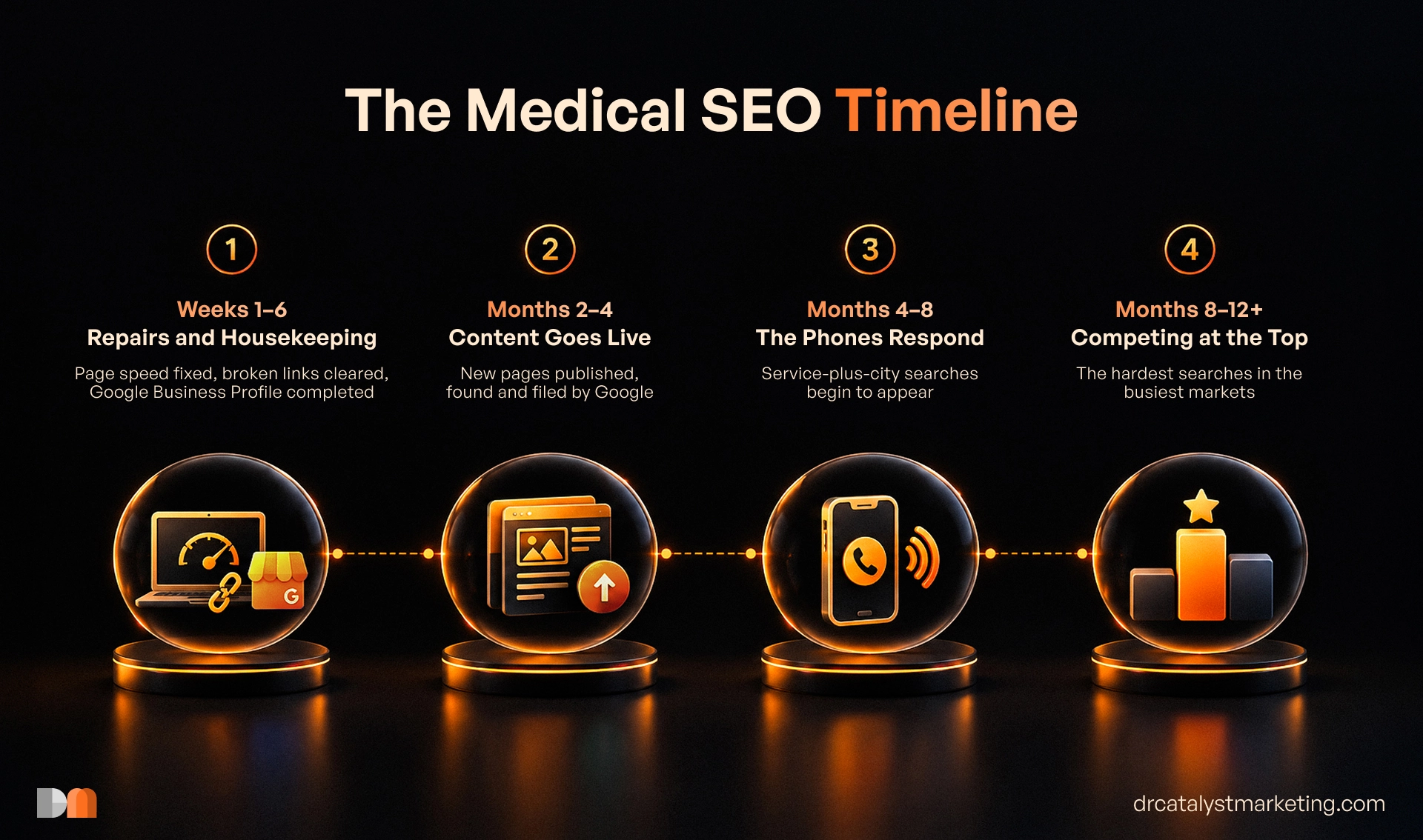
The delay in SEO for medical practices comes down to four things. These are elaborated below-
Google does not see new pages immediately. It has to find your page, read it, decide what it covers, and work out where it belongs against everything already ranking for that search. Think of a records department that receives a chart, reviews it, and decides which drawer it belongs in. None of that happens the moment you hit publish.Credibility builds on its own. A site that published forty pages last month reads very differently to Google from one that has published steadily for three years. It behaves more like a referral relationship than a light switch, and the shortcuts that skip this step usually cost more later than they save now.
Your competitors started earlier. The practices above you in search rankings have been at this for a while. Catching them means producing better work than they did and then waiting for that work to be recognized.
The results page itself keeps changing. Google now answers many questions with an AI-written summary at the top of the page, which means fewer people click through to any website. Pew tracked nearly 69,000 Google searches and found people clicked through to a result in 8% of visits where one of those summaries appeared, against 15% where none did. Clear, credible, clinician-backed pages are the ones those summaries tend to quote.
Your specialty changes the curve too. A fertility clinic with a small number of high-stakes pages and patients who research for months is a different problem from a twelve-location orthopedic group managing hundreds of listings. Our piece on SEO for fertility clinics explains why the same approach doesn't transfer between them.
12 years and more than 40 specialties mostly means that we know what month four looks like for a solo dermatology practice and what it looks like for a twelve-location orthopedic group. Search is one instrument for us from the whole orchestra of patient acquisition, medical SEO, local search, Google and Meta ads, website design and conversion, content, video, social media, reputation management, and reporting that a practice administrator can read without a translator. Over 200 providers have grown with us, and 95% of clients stay. In a category where anybody can win an account, that last figure is the one we would look at if we were you. If you want a straight read on where your practice stands today, talk to our team.
The realistic arc for SEO for medical practices is four months before you expect much. Six to eight months before the phones reliably show it. Twelve before you are competing for the searches you want. Faster if your website is healthy and your market is small. Slower if neither is true. One last thing worth holding onto while you wait. Judging the work on new patient numbers alone undercounts it, because the same pages are doing quiet work with referring physicians, job candidates, partner organizations, and the patients already on your books. Those returns are often the ones a practice values most in hindsight.
Every specialty has its own patient journey. We know the difference between how someone searches for a fertility clinic and how they find urgent care.