Get a FREE marketing audit and discover what's holding your practice back from reaching its full potential.
Search "best medical SEO agency" and you'll get about forty lists. Open three of them, and you'll find the same quiet joke: every list ranks the agency that wrote it first. This one won't pretend otherwise. DrCatalyst Marketing shows up below, and we think it's the right call for a specific kind of practice. The rest of this article is us trying to help you figure out if that's true for yours, whether the answer ends up being us or somebody else on the list.
Here's why it's worth getting right. A study in Public Health Reports tracked four national surveys and found that 74.9% of US adults went online first the last time they needed health information, up from 61.2% a decade earlier. The practices that show up clearly in that search get the call. The ones that don't, don't. This article breaks down what these agencies do, so you can work out which kind fits yours.
Here's the case for us, briefly: twelve-plus years doing only this, 40+ specialties, over 200 providers, and a 95% client retention rate in an industry where practices switch agencies often. Paired with full-service execution across SEO, HIPAA compliance, Google's E-E-A-T standards, and the shift toward AI-driven search answers, that's why we think DrCatalyst Marketing is the best fit for a growing independent or multi-location practice that wants one team handling all of it instead of five vendors.
SEO vocabulary can make it sound more technical than it is. The work comes down to three things, and each one is straightforward to picture once it is described plainly.
The same pages a prospective patient reads are the pages a referring physician skims before sending someone your way. They are what a candidate reads before accepting your job offer, and what a payer or partner organization finds when they look you up. Search visibility is infrastructure. There is a second reason to care about being clear rather than merely visible. Pew surveyed 5,111 US adults in late 2025 and found that 76% run into conflicting health information, and 54% cannot work out which source to believe. A practice whose pages answer plainly does something useful for people long before any of them book anything.
You may reasonably wonder why a healthcare practice cannot just hire whoever did the website for the restaurant down the road. Three reasons, and all of them are peculiar to this industry.
Below are the best medical SEO agencies, with descriptions that reflect how each firm positions itself publicly.
All are real firms doing real work. None of them is the best, because "best" isn't a property an agency has on its own.
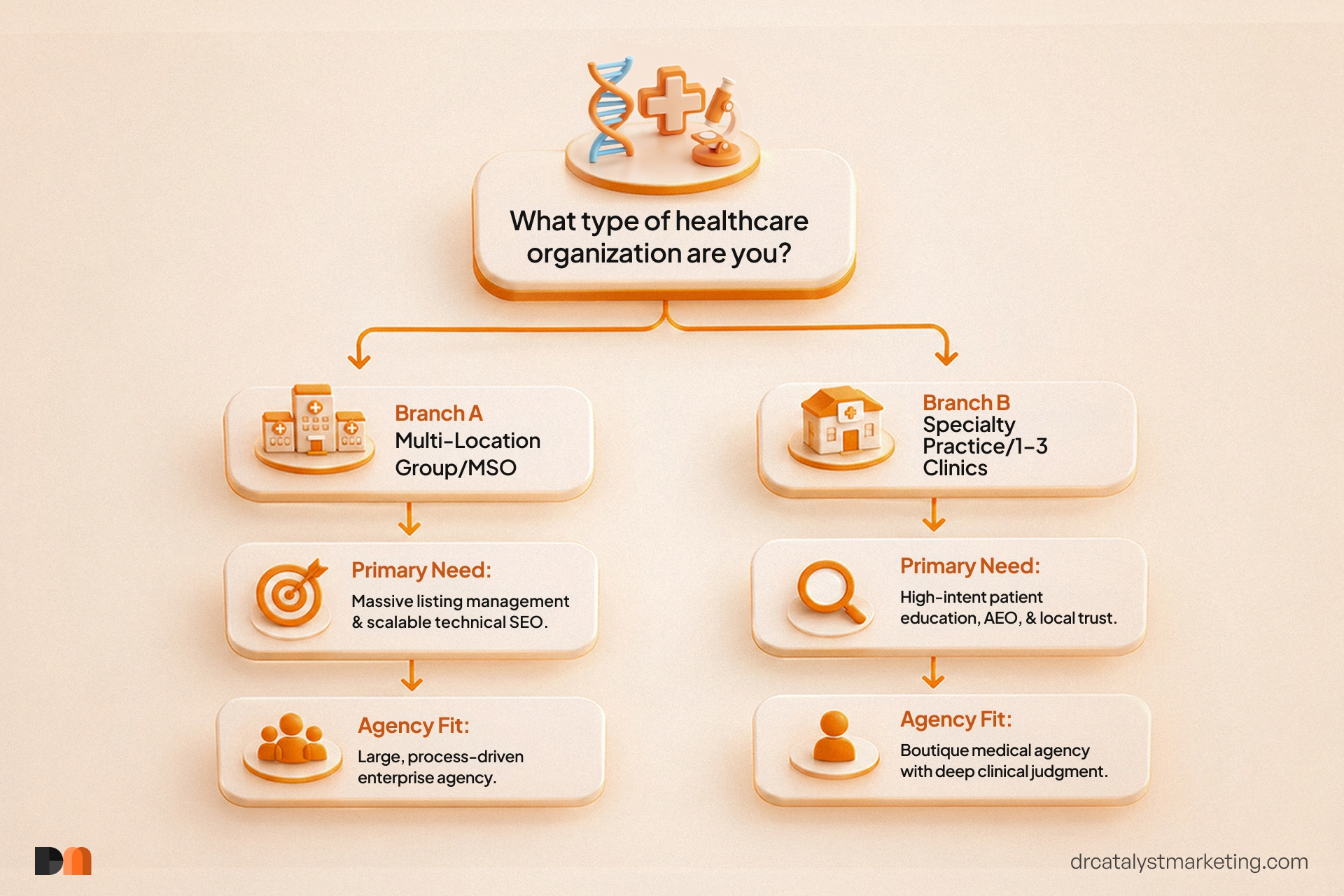
A medical marketing agency is a shape. Your organization is also a shape. The question is whether the two fit, and a firm that is brilliant for one kind of client is often actively wrong for another.
A twelve-location orthopedic group needs consistency at scale. Hundreds of listings, dozens of providers, a system for keeping it all straight when someone moves offices. That is a process problem, and the agencies built for it have process to spare.
A two-physician fertility clinic has the opposite problem. A small number of pages, enormous emotional weight on each one, patients who research for months before making a call and who read everything. That is a judgment problem, not a process one. Our piece on SEO for fertility clinics gets into why the same playbook fails there.
Then there is the vocabulary question, which sounds trivial but isn't. Every specialty has its own language, and it rarely matches what patients type. Allergy patients search for the season, not the allergen. Dermatology patients describe what they can see. A generalist agency will build you beautiful pages around words nobody uses.
If you are running a specialty practice, our guide to choosing the best SEO company for a specialty practice walks through the questions that separate a firm that has done this from one that has read about it.
One more distinction worth keeping in mind. There is a difference between a marketing services company that has a healthcare page on its website and a medical marketing agency where healthcare is the only thing anyone has ever worked on. Both can do good work. Only one of them already knows what a superbill is, and that shows up in how many meetings you spend explaining your own business.
We are the second kind with 12+ years, more than 40 specialties, over 200 providers, and 95% of clients who stay. That last number is the one we would look at if we were you, because in this industry anybody can win an account and far fewer can keep one.
We're not a search-only shop. Search is one instrument. The work also spans paid advertising on Google and Meta, website design and conversion, content, video production, social media, reputation management, and reporting that a practice administrator can read without a translator. Practices come to us for different reasons: some want more new patients, others want to protect a reputation, strengthen referral relationships, fill provider vacancies, or simply find out why their existing agency's reports look excellent while the phones do not ring.
We work across specialties and have seen which patterns transfer and which do not. A tactic that transformed a dermatology group will not necessarily do anything for a behavioral health practice, and knowing the difference in advance is most of what you are paying for. Our medical SEO services sit inside that wider picture rather than being sold as a standalone cure.
None of these require you to know how a search engine works. They require you to listen properly to the answers, and to notice when one is missing.
Three in four American adults look online first when they have a health question. Being findable is closer to having a working phone line.
The listed medical SEO agencies are genuinely different from one another, and the differences are about fit, not quality. Enterprise process suits enterprise problems. Specialty judgment suits specialty practices. The mismatch is what wastes money, not the price.
And search visibility earns its keep in more places than the appointment book. If you want a straight assessment of where your practice currently stands, talk to our team.
Every specialty has its own patient journey. We know the difference between how someone searches for a fertility clinic and how they find urgent care.