Get a FREE marketing audit and discover what's holding your practice back from reaching its full potential.
A couple has been trying to conceive for a year. One night, after another negative test, one of them types "fertility doctor near me" into a phone. What they find in the next ten minutes, your website, reviews, and a short video of your physician, will shape whether they ever call your clinic. Infertility is more common than many people realize. According to the Centers for Disease Control and Prevention (CDC), about 1 in 5 women aged 15 to 49 with no prior births can't get pregnant after a year of trying.
Many of those patients start their search online, often before they tell friends or family. That's why fertility clinic marketing matters. It helps patients understand their options, trust your team, and feel supported through a long and emotional process. This guide covers ten practical strategies, a checklist for the year ahead, and how it all fits together. If you run an in vitro fertilization (IVF) program, our guide to digital marketing strategies for IVF clinics goes deeper on that specialty.
Many physicians think marketing is just advertising. In reality, it's every point where a patient learns about you, from the first search result to the follow-up email after a consultation. Fertility care is also growing fast. According to the American Society for Reproductive Medicine (ASRM), U.S. clinics performed 449,772 IVF cycles in 2024, and more than 100,000 babies were born through IVF that year, a first. More patients are seeking care, and more clinics are competing for their choice.
So, fertility services marketing has several jobs at once. It educates patients who are just starting to learn. It builds trust before the first appointment. It keeps current patients informed during treatment, encourages reviews and referrals, and protects your reputation. New bookings come from doing all of that well.
These fertility clinic marketing strategies work best together. You don't have to launch all ten at once, but each one supports the others.
A 32-year-old trying for her first child, a same-sex couple exploring donor options, and a 38-year-old thinking about egg freezing all have different questions. Before you write a single ad, list the patients you serve most and what each one worries about. Your messaging gets clearer when it speaks to your target audience.
Patients often compare several clinics. Maybe yours offers same-week consultations, a dedicated nurse for each patient, or financing help. Pick the two or three things that truly set you apart and repeat them everywhere, from your website to your social profiles.
Most fertility patients look for care close to home. That makes local search engine optimization (SEO) essential. Claim and complete your Google Business Profile, keep your hours and address consistent across directories, and create a page for each service you offer. Our guide to SEO for fertility clinics walks through each step. Search is also changing. More patients now see artificial intelligence (AI) answers at the top of the results page. Answer engine optimization (AEO), which means writing clear answers to common questions, helps your clinic show up there too.
Your website does more work than most clinics realize. In a study published in Fertility Research and Practice, almost all patients who viewed a clinic's online educational material reached it through the clinic's website, and two-thirds said it helped them prepare for treatment decisions. So make it easy. Explain each treatment in plain language, show your team, list what a first visit looks like, and offer online booking. Make sure it loads fast on a phone, since that's where many patients will find you.
Patients have many questions, and they want answers before they commit. Blog posts, FAQs, and treatment guides on topics like "What happens during an IVF cycle?" or "When should I see a fertility specialist?" build trust and support your search rankings. Our guide to healthcare content marketing explains how to turn everyday patient questions into useful content.
Video helps patients feel familiar with your physicians before they meet. The same Fertility Research and Practice study found that 65.6% of patients preferred video to text. A separate 2024 study in the Journal of Assisted Reproduction and Genetics found YouTube was the platform people preferred for following a fertility clinic's educational content. Start with short provider introductions and simple explainers about each treatment.
Social media isn't only for promotion. For fertility patients, it can provide education, encouragement, and community. Share myth-versus-fact posts, team spotlights, awareness month content, and success stories shared with written consent. Our guide to Instagram marketing for doctors covers what to post and how often.
Patients read reviews before they book, and for such a personal decision, they read closely. Ask satisfied patients for reviews at the right moment, respond to every review professionally, and never share patient details in a reply. A steady stream of honest reviews tells new patients that people like me trust your clinic.
Google and Meta ads can reach people actively searching for fertility care in your area. Build each ad around one service, send it to a matching landing page, and track every call back to its campaign. Fertility is a sensitive category, so review each platform's health ad policies and make sure no tracking tools share protected patient information.
Many patients aren't ready to book after their first visit to your website. A short email series can share helpful information, answer common concerns, and invite them to a consultation when they're ready. For current patients, email works well for appointment reminders and treatment updates.
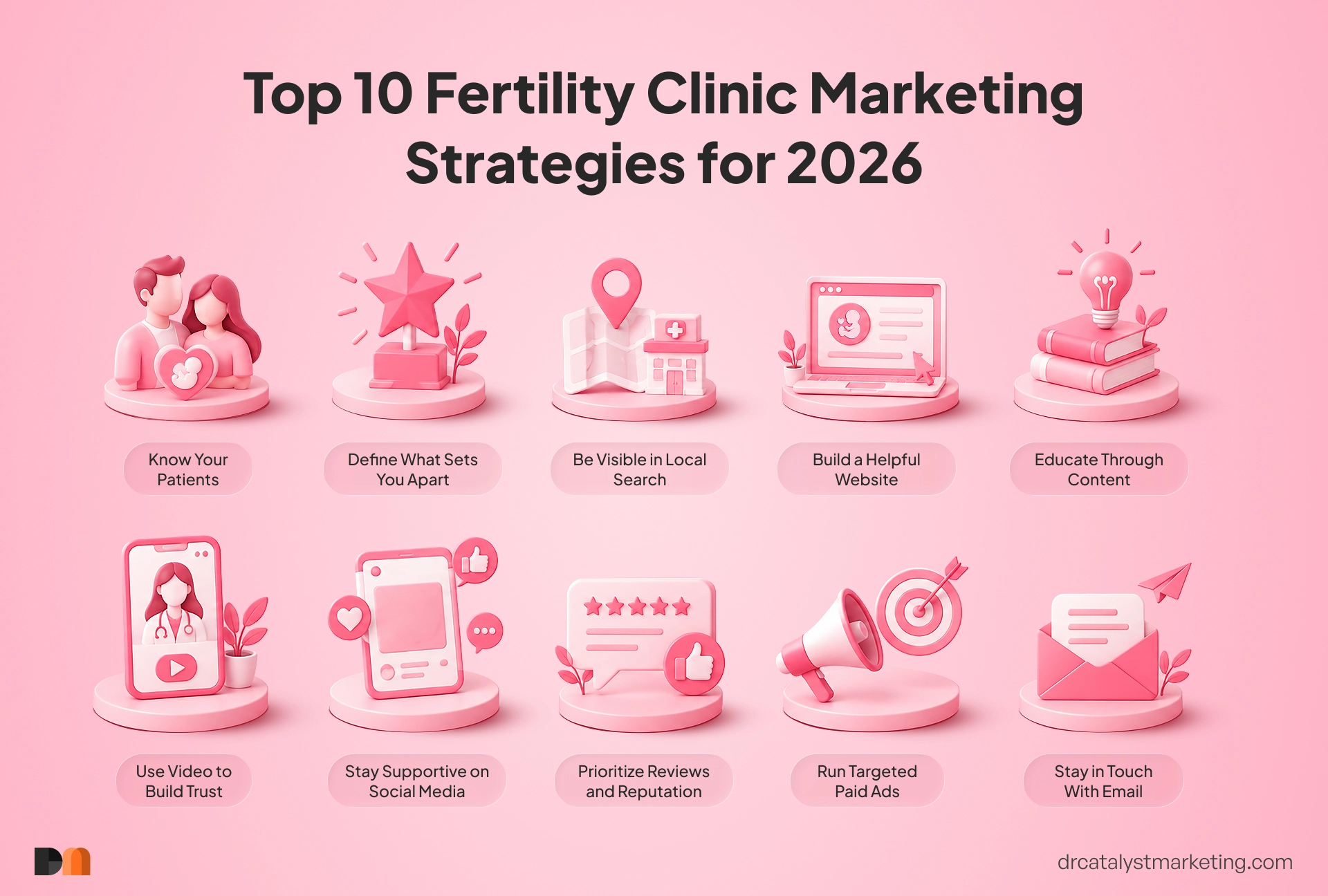
Use this checklist to see where your clinic stands and what to tackle next as you plan your fertility marketing strategies for 2026:
Fertility patients may be unique, but trust-building works the same across specialties. Dr. Tushar Patel of CMC Fresno said our team was "effectively nailing the tone and messaging that align with my pediatric practice and patient demographics." Fertility clinics need that same care with tone, because patients are often anxious and want to feel understood. Consistency matters too. As Dr. Rima Sanka of AAAC put it, our team helped her practice "build a stronger online presence and connect more effectively with current and prospective patients." That connection with both current and future patients is what strong fertility clinic marketing is really about.
DrCatalyst Marketing has spent 12+ years helping practices across 40+ specialties, including fertility and reproductive health, grow their marketing with the realities of healthcare. Our team handles custom websites, local SEO and AEO, social media, Google and Meta ads, video production, content, email, and reputation management. We've served 200+ practices and maintain a 95% client retention rate because we start by listening to your requirements. As John Freiler, Founder of Premier Allergy of Texas, shared, "Their social media management has also boosted our visibility and patient engagement."
Fertility patients take their time, ask many questions, and look for a clinic they can trust. Fertility services marketing that gives them clear answers, real faces, and steady communication does more than bring in new patients. It supports them before, during, and after treatment. Start with the basics: get recognized locally, build a helpful website, and earn honest reviews. Then add content, video, social media, and email as your capacity grows. If you'd rather have a partner handle it, contact DrCatalyst Marketing to talk about your clinic's goals.
Every specialty has its own patient journey. We know the difference between how someone searches for a fertility clinic and how they find urgent care.