Get a FREE marketing audit and discover what's holding your practice back from reaching its full potential.
Imagine it’s the start of your week and you’re staring at a half-empty schedule. Fifteen years in practice, a wall of grateful patient notes, outcomes most clinics would envy. But none of it is filling the open slots. Meanwhile, across town, a patient who needed exactly your expertise just booked with someone else. Not a better provider, but definitely a more findable one online. That's the uncomfortable truth of the healthcare industry in 2026: patients search online before they ever book an appointment.
The global healthcare market will reach $665.37 billion by 2028, according to Verified Market Research. That kind of growth means one thing for doctors: the way patients discover, evaluate, and choose their care is shifting online faster than most practices are prepared for. This is the new reality of digital marketing for doctors. At DrCatalyst Marketing, we've spent over a decade helping physicians and medical practices cut through the noise and attract the right patients.
The patient acquisition landscape has experienced a monumental shift. In 2026, patients look for a physician with the same digital-first scrutiny they apply to booking a hotel or picking an enterprise software platform. They cross-reference insurance eligibility systems, scour video testimonials, evaluate online review transparency, and expect interactive self-scheduling paths.
Investing in comprehensive digital marketing for doctors is no longer just a luxury operational choice; it is a baseline necessity to protect your market share. Without an active, data-driven web presence, your clinic remains completely invisible to the generation of patients driving modern healthcare consumption.
Modern medical practice marketing demands an approach that blends clinical compliance with digital experiences, transforming passive online browsers into lifelong loyal patients. But knowing that marketing matters is different from knowing where to start.
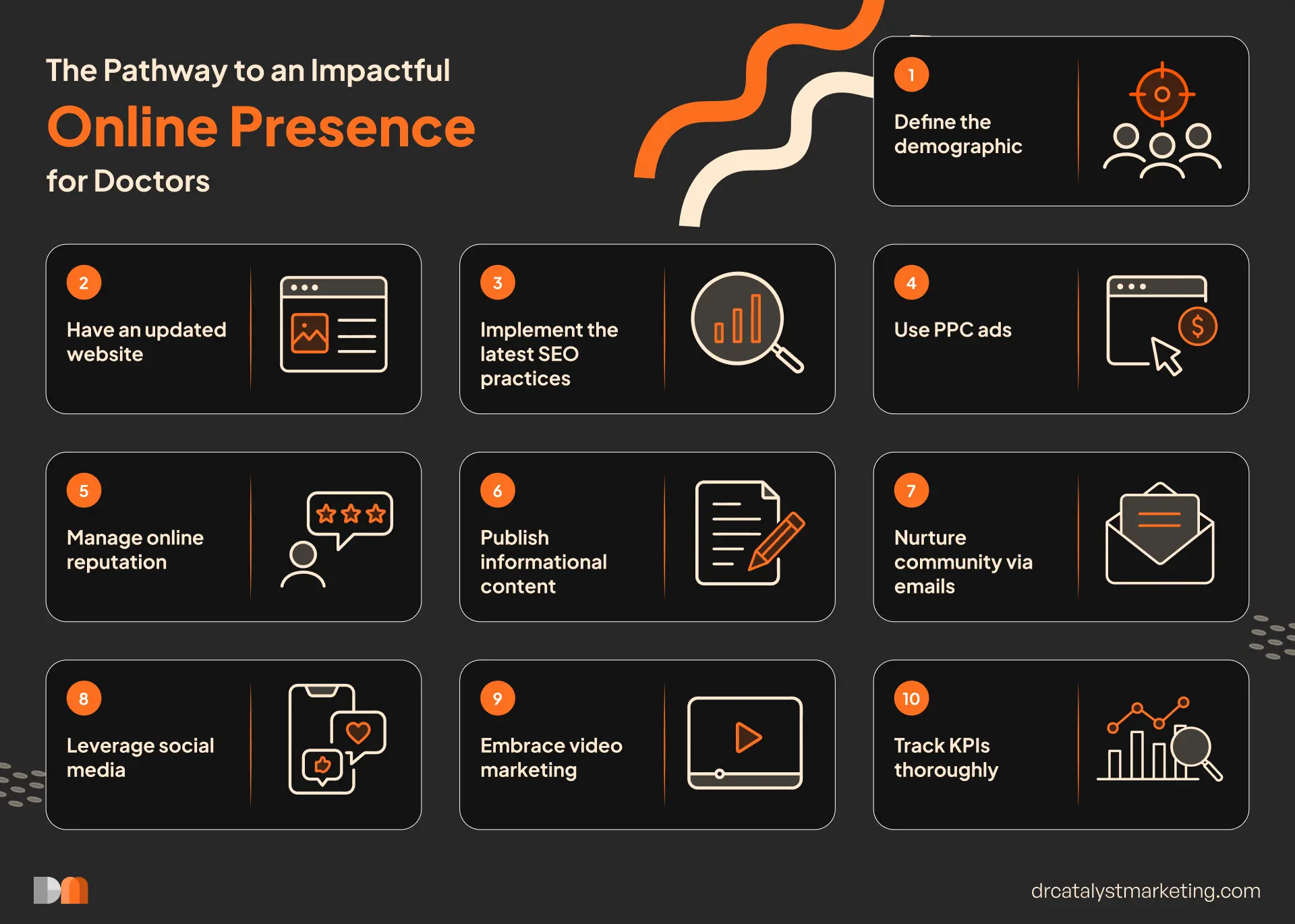
The rest of this guide walks that path in the order a patient actually moves through it, beginning with the audience you're trying to reach, then the website that converts them. These channels drive them there, the trust that makes them choose you, and finally the analytics that prove what's working.
Before you spend a single dollar on marketing ads, stop and ask: who are you actually trying to reach? A pediatric practice and a cosmetic dermatology clinic do not speak to the same audience, and pretending otherwise is where most marketing strategies for doctors quietly fail.
Build out a patient persona: age range, common concerns, preferred communication style, even the specific worries that keep them Googling symptoms at midnight.
The best medical marketing strategies start here, not with a flashy ad campaign, but with a genuine understanding of who's on the other side of the search bar. Once you know exactly who you're speaking to, you need somewhere to send them, and that's where your website comes in.
Your website is often the first interaction a patient has with your practice. In 2026, a high-performance website must do more than look good. It should be fast, mobile-friendly, secure, easy to navigate, and optimized to convert visitors into appointment requests or calls.
At DrCatalyst Marketing, we do digital marketing for doctors. Your website answers the questions patients care about most: who you treat, what conditions you manage, where you are located, what insurances you accept, and how to book. We incorporate clear calls to action, easy forms, provider bios, condition pages, and strong trust signals, all of which are important components.
The best websites support digital marketing for medical practices by acting as the central conversion hub. Whether traffic comes from search, social, paid ads, or referrals, the website should guide patients toward the next step without friction.
If your site is outdated or hard to use, even strong marketing campaigns may underperform. Of course, a high-performing website only works if patients can actually find it, and that job belongs to search, starting locally.
When a nearby patient searches "allergist near me" or "best pediatrician in the city" they rarely look past the top Google Maps Pack entries. Winning these premium spots requires a dedicated local SEO framework tailored specifically to digital marketing for medical practices.
Claim and thoroughly optimize your local profiles. Ensure your practice Name, Address, and Phone number (NAP data) remain completely identical across every directory index on the web. Build localized landing pages detailing specific geographic areas your clinic serves, and map your metadata to capture local high-intent phrasing to maximize your local market authority.
SEO is a marathon. Pay-Per-Click (PPC) is the sprint you run alongside it. Where local SEO builds authority over months, paid search delivers patients the moment you need them. Paid search ads let you show up instantly for high-intent searches like "urgent care near me" or "best dermatologist in [city]," capturing patients who are ready to book right now, not just browsing.
The catch, of course, is budget. Understanding realistic digital marketing costs for doctors' clinics up front prevents the classic mistake of overspending on broad keywords while underinvesting in the specific, high-converting ones that actually bring patients through the door. But whether a patient arrives through organic search or a paid ad, almost all of them do one more thing before they book: they check what other patients have said about you.
Reputation management is a critical part of medical practice marketing because patients trust reviews almost as much as referrals. In 2026, online reviews can influence whether a patient contacts your office, chooses another provider, or continues searching.
Encourage happy patients to leave feedback, respond professionally to reviews, and monitor your online presence across major platforms. Your reputation should reflect the quality of care you provide. Negative reviews are not always avoidable, but a strong review strategy can help you build credibility over time.
For online marketing for doctors, reputation management should be treated as an ongoing process. It supports conversion, search visibility, and long-term brand strength. Reviews, though, are reactive; you earn them after the visit. The next four channels let you build trust proactively, long before a patient ever walks through your door: content marketing, email, social media, and video.
Patients are constantly searching the web for health advice. By publishing accurate, clear, and engaging answers to your clinic's most frequent questions, you build immediate clinical authority and become the answer your patients are searching for! Content creation is one of the best digital marketing strategies for doctors looking to build long-term trust.
Develop a structured blog pipeline focusing on preventative wellness tips, symptom explainers, and treatment overviews. Not only does this show prospective patients the depth of your medical care, but it also provides a massive volume of keyword-rich, indexable text that search engine crawlers reward with higher organic rankings. Content is how you bring new patients in; email is how you hold on to the ones you already have.
New patient acquisition gets all the attention, but retaining existing patients is often cheaper and more valuable. Appointment reminders, seasonal health tips, and post-visit follow-ups keep your practice top-of-mind, and happy, engaged patients are far more likely to refer friends and family. It's a quiet workhorse in the world of digital marketing for doctors, unglamorous, but consistently effective. And where email nurtures patients privately, social media builds that same trust in public.
Social media is not just for brand awareness. In 2026, it is an important platform for building trust in healthcare. Patients want to see the people behind the practice, understand the culture, and feel comfortable before reaching out. That makes social media an essential part of marketing for medical practices.
Share educational content, provider spotlights, behind-the-scenes moments, testimonials, community involvement, and patient-centered tips. Keep the tone approachable and professional. The best social media strategies for doctors focus on connection, not just promotion. For digital marketing for doctors, social media helps humanize the brand and support visibility across multiple patient touchpoints. And within social, one format now outperforms all the rest.
Video content is king. A short, empathetic video clip of a physician explaining a complex condition can do more to alleviate patient anxiety than a ten-paragraph article ever could. The latest healthcare marketing trends 2026 point heavily toward vertical, short-form video content.
At DrCatalyst Marketing, we incorporate quick physician introductions, video FAQs, and facility walkthroughs on your digital channels. Additionally, consider integrating automated tools, such as AI chat assistants, on your website. These tools can guide online browsers to the right clinical department and answer simple logistical questions 24/7, reducing friction and maximizing conversions.
None of the above matters if you're not measuring it. Which channels are actually driving booked appointments, not just clicks? Which ad is burning the budget with nothing to show for it? Conversion-focused analytics, tracking calls, form submissions, and booked visits rather than vanity metrics like impressions, is what separates digital marketing services for doctors that deliver real ROI from ones that just deliver a nice-looking report. Running all of this, and reading the data well enough to act on it, is a lot to ask of a practice that already has patients to see. That's exactly where a specialist partner earns its keep.
Many practices try to manage everything internally, but digital marketing for doctors often works best with expert support. A digital marketing agency for doctors understands compliance, patient behavior, specialty positioning, and the realities of healthcare operations.
At DrCatalyst Marketing, we can help you with website strategy, local SEO, paid ads, reputation management, content development, and campaign tracking. We can also help you understand digital marketing costs for doctors' clinics and ensure your budget is used effectively.
If your team is stretched thin, partnering with our healthcare-focused agency can improve consistency and results. You can also contact us for a deeper understanding of what a structured approach will look like for your clinic.
Remember Dr. A and her half-empty schedule? The gap between a practice patients can't find and one they can't stop recommending is where all of these pieces work together as a single machine. Building a commanding presence online takes time, consistent effort, and a willingness to adapt to the latest technological innovations. By aligning your website execution, local search optimization, paid advertising, and reputation management into one cohesive machine, you protect your business and establish your clinic as a trusted pillar in your community.
The digital sandbox will continue to evolve, but the core principle remains identical: make it as simple, reassuring, and secure as possible for an online patient to choose your practice. Take it one step at a time, rely on proven data, and let your clinical excellence shine through your digital front door. Learn more.
Every specialty has its own patient journey. We know the difference between how someone searches for a fertility clinic and how they find urgent care.