Get a FREE marketing audit and discover what's holding your practice back from reaching its full potential.

Nearly one in three American adults spends the year sneezing, itching, or reaching for an inhaler. The CDC’s National Center for Health Statistics puts it at 31.8% of adults with a seasonal allergy, eczema, or food allergy in 2021.
Scale that national number down to your city, and it adds up to thousands of people living near your clinic who need exactly what you offer. So it is a little strange that so many allergy practices still have open slots on the schedule.
The demand is right there. The patients just cannot find you. That gap between “lots of demand” and “empty 2 p.m. slot” is exactly what allergy practice marketing is built to close.
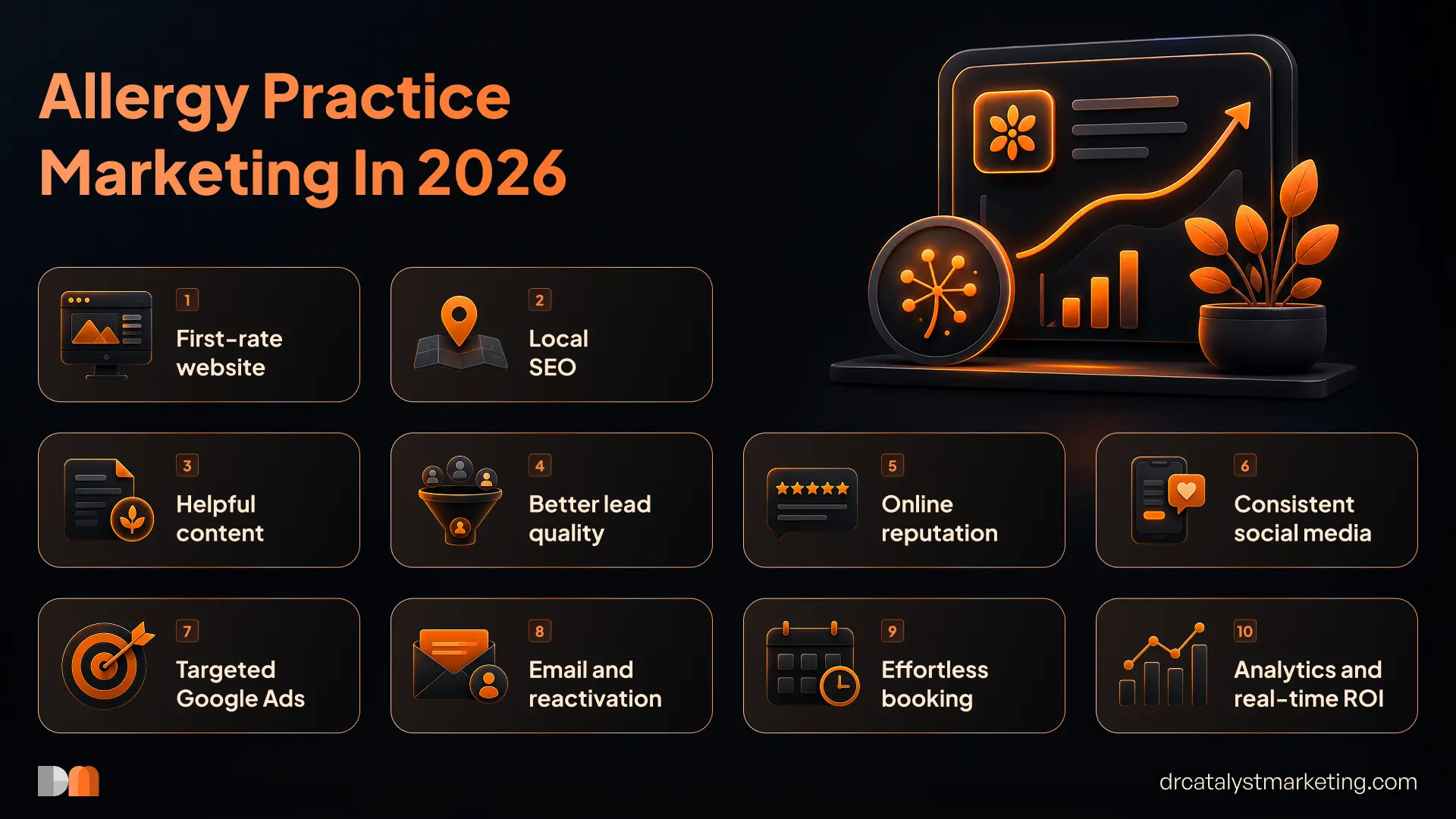
Think of this as your guide to allergy & immunology digital marketing services for 2026, minus the jargon and the 40-slide deck. Ten strategies, one clear thread: help the right patients find you, trust you, and book you. Let us start with why any of this matters.
Patients no longer ask a neighbor for a doctor. They ask a search bar at 11 p.m. while a toddler coughs in the next room. If your clinic does not show up in that moment, someone else’s does.
That is the whole case for medical marketing for allergy clinics: you are not buying attention, you are meeting people who are already looking. None of the fundamentals here are mysterious. Many carry over from general practice growth, which we cover in Digital Marketing for Doctors.
The rest is about tailoring those fundamentals to how allergy patients actually search and decide. Everything below builds on the same foundation, so let us pour it first: your website.
Your website is the first handshake, and patients decide in seconds. If it loads slowly, hides your phone number, or looks like it was last updated during a pollen surge in 2014, they bounce. Strong allergy clinic digital marketing starts with a site that is fast, mobile-friendly, and honest about what you treat.
Make the essentials obvious: services, insurance, location, and a booking button that works on a phone. Elaborate on the actual worries, like “will my child need shots” and “how long is a visit.” A clear site does not just look nice. It feeds every other strategy on this list, starting with how you are found in the first place.
A beautiful website nobody finds is a very expensive business card. That is where allergy clinic SEO earns its keep. Optimize for local search so you appear when someone types “allergist near me” or “food allergy testing” in your city. Claim and polish your Google Business Profile, keep your name, address, and phone consistent everywhere, and target the terms patients actually use.
This is technical enough that most practices bring in help, and choosing the right partner matters. Our take on the best SEO company for allergy clinics walks through what to look for, and our healthcare SEO services are built for exactly this kind of specialty search. Once people can find you, you have to give them a reason to stay, which brings us to content.
Allergy patients are anxious and curious, a combination that lives on search engines. Answer their questions before they ask, and you become the trusted voice in the room. A simple post on “seasonal vs. year-round allergies” or “what to expect from immunotherapy” does double duty: it reassures patients, and it strengthens your allergy clinic SEO at the same time.
Content also gives you something to share everywhere else, which is a theme you will notice repeating. Write once, use it ten times. And the more helpful your content, the more it quietly pre-qualifies the people who reach out, which matters more than you might think.
More leads sound great until your front desk is buried in calls from people three states away who wanted a dermatologist. Volume is a vanity metric. In smart allergy marketing, quality beats quantity every time.
Tune your targeting, your forms, and your ad copy so the people who reach out actually match the patients you want. Ask a qualifying question or two on your contact form. Track which channels send bookers, not just clickers. Better leads mean a happier team and a fuller schedule, and they set up the next step nicely: turning happy patients into your loudest marketers.
Before booking, patients read reviews the way they read a weather forecast during allergy season: closely, and with a little dread. A steady stream of recent, genuine reviews is one of the most persuasive assets in allergy clinic marketing. It is social proof that no ad can fake.
Make asking for reviews a habit, respond to every one with grace, and treat the occasional critical note as free feedback. A strong reputation lifts your local search rankings and your conversion rate at the same time. Once your reputation is working, it is worth showing up where patients already spend their time.
Social media will not replace clinical care, but it is where trust gets built between visits. Short, friendly posts about pollen counts, allergy myths, or a quick “meet the team” clip keep you top of mind. Think of it like a helpful neighbor, not a billboard.
You do not need to be everywhere. Pick one or two platforms your patients actually use and post consistently. This is the human side of allergy and immunology marketing, and it pairs perfectly with the paid strategy that can accelerate everything: Google Ads.
SEO is a marathon. Google Ads is the sprint you run alongside it. When someone searches “allergy testing today,” a well-built ad puts you at the top of the page right when intent is highest. For a growing practice, that speed is hard to beat.
The trick is discipline. Target high-intent keywords, send clicks to a focused landing page, and cap wasted spend on terms that never convert. Paired with the lead-quality habits from earlier, Google Ads becomes a reliable tap you can turn up or down. And once patients are coming in, the goal shifts to keeping them.
Acquiring a new patient costs far more than keeping an existing one, yet email is the most neglected tool in healthcare marketing for allergists. A simple seasonal reminder (“time to prep for spring”) or a gentle “we have not seen you in a while” note brings people back without spending a cent on ads.
Segment your list, keep messages short and useful, and always give patients an easy next step. Retention is quietly one of the highest-return moves you can make, and it works even better when booking is effortless.
You can win the search, the click, and the trust, then lose the patient at a clunky booking form. Every extra field is a small invitation to give up. Online scheduling, clear availability, and a mobile-first flow turn interest into an actual appointment.
Reduce friction wherever you can: fewer clicks, clear confirmation, easy rescheduling. This is where all the earlier work finally pays off in a booked slot. And to know which of these strategies is actually filling those slots, you need to measure.
Marketing without measurement is just expensive guessing. The final strategy ties the other nine together: track what works in real time so you can double down on winners and quietly retire the rest. Watch cost per booked patient, not just clicks and impressions.
Set up call tracking, form tracking, and a simple dashboard your team will actually check. When you can see ROI as it happens, every decision gets sharper. That is the difference between spending on marketing and investing in it.
Notice how each strategy is handed off to the next. A fast website feeds SEO, SEO feeds content, content feeds social and reputation, ads accelerate demand, email and easy booking convert it, and analytics tells you what to do more of. That is not ten separate tactics. It is one system.
You do not have to build it alone, or all at once. Whether you focus on allergy, asthma, and immunology services or general practice growth, the right partner can help you start where it matters most and grow from there. The patients are already searching. In 2026, allergy practice marketing is simply how you make sure they find you first.
Building that system is our full-time job. DrCatalyst Marketing works with allergy and immunology practices to turn scattered tactics into one engine that fills the schedule. We run the parts most clinics do not have the hours for: the website, the allergy clinic SEO, the review engine, the Google Ads, and the reporting that shows exactly what each dollar brought back. You stay focused on patients. We stay focused on sending you more of them.
Not sure which of these would help your practice most? Start with a free marketing audit. We will map how your practice shows up in local search, find where prospective patients quietly drop off, and pinpoint the two or three moves that would fill your calendar fastest. No sales pitch, no obligation, just a clear read on what is working and what needs attention. Book your free allergy marketing audit, and let us show you where your next patients will come from.
Every specialty has its own patient journey. We know the difference between how someone searches for a fertility clinic and how they find urgent care.