Get a FREE marketing audit and discover what's holding your practice back from reaching its full potential.
A woman in her fifties types “do I need a sleep study or just a better pillow” into Google tonight. Google’s AI Answer Engine answers her at the top of the page. She reads it, closes the tab, and goes to bed.
Pew Research tracked 900 American adults across almost 69,000 searches to find out how often that happens. When an AI summary sat at the top of the page, 8% of people clicked through to a normal search result. With no summary on the page, 15% did. Only 1% clicked one of the sources listed inside the summary itself.
Nobody won that visit. She stopped reading before the page reached anyone’s website.
Ten years ago you could watch buyer research happen. Someone searched, opened three or four sites, and either called or didn’t. Your analytics showed most of it. When the numbers got worse, you usually knew roughly why.
A lot of that comparison now happens in a paragraph above the results. A summary might explain the procedure, run through what to look for in a provider, mention rough cost, and name a specific practice. If it names yours, you are on the shortlist before anyone else knows there is one.
Most practices treat this as a traffic problem, because sessions are the number that drops. The comparison itself has moved into a place their analytics never sees. Budgets for digital marketing for doctors were built around a visitor who shows up on the site.
AI Overviews do not appear evenly across the web. WebFX ran 130,070 US health-related searches through a SERP (search engine results page) tool in July 2025. The tool runs searches in bulk and logs what appeared on each one. It found an AI summary on 51% of them. Across all industries combined, the rate sits at roughly half that.
Length matters a lot here. A one- or two-word search returned a summary 35.8% of the time. Push the query to seven words or more, and it jumps to 73.9%. Nobody researching a symptom at eleven at night types two words.
So Google answers the thorough researchers itself and sends them nowhere. Add the Pew click numbers, and someone who researches properly is about half as likely to land on any practice website. You can see the same thing happening across AI-driven lead generation in any channel that leans on search.
For twenty years, the results page had a shape everyone understood. Ads at the top, then the map pack, then the organic listings, each with its own rules. AI Overviews sit above all three.
Google started running ads inside and next to AI Overviews in the US during 2025, and has been extending that to other English-speaking markets since.
So third place organically means less than it did two years ago. A paragraph above may already answer the question, and it may include an ad as well.
The same health study turned up something more useful, and hardly anyone is talking about it. Searches containing a brand name returned an AI Overview 38.2% of the time. Searches with a location attached, the “near me” and “in Sacramento” variety, came in at 42.5%. Both sit well below the 51% healthcare average, and nowhere near the 73.9% that long informational questions pull.
Google answers condition searches itself. Add a practice name or a city to the query, and it is much more likely to show results.
So anything that moves people from unbranded searching toward branded or local searching helps you here too. Reviews help. So do referrals, and so does simply being known well enough that patients search you by name instead of by symptom. Practices that took online reputation management seriously three years ago were building AI resilience without meaning to. AI search optimization is the only form that survives an algorithm update.
Google AI Overviews optimization involves systems assembling these summaries. They want clear answers, structured pages, visible authorship, and sources that look trustworthy on health topics. Good medical content already does most of that.
A handful of things genuinely move the needle. Put the answer in the first two sentences of the page, ahead of the background and the caveats. Build pages around the questions patients ask instead of the services you sell, since those use different words. Get providers, locations, and credentials into structured data. Date your clinical pages and keep them current, because a system trained to be careful about health advice reads an outdated 2019 page as a risk.
Some of this traffic is gone, and planning around its return wastes the budget. Google AI Overviews for businesses comes down to two aims: getting cited inside the summary, and making sure the visits you still receive are the ones close to booking. Our AI SEO services work on both at once.
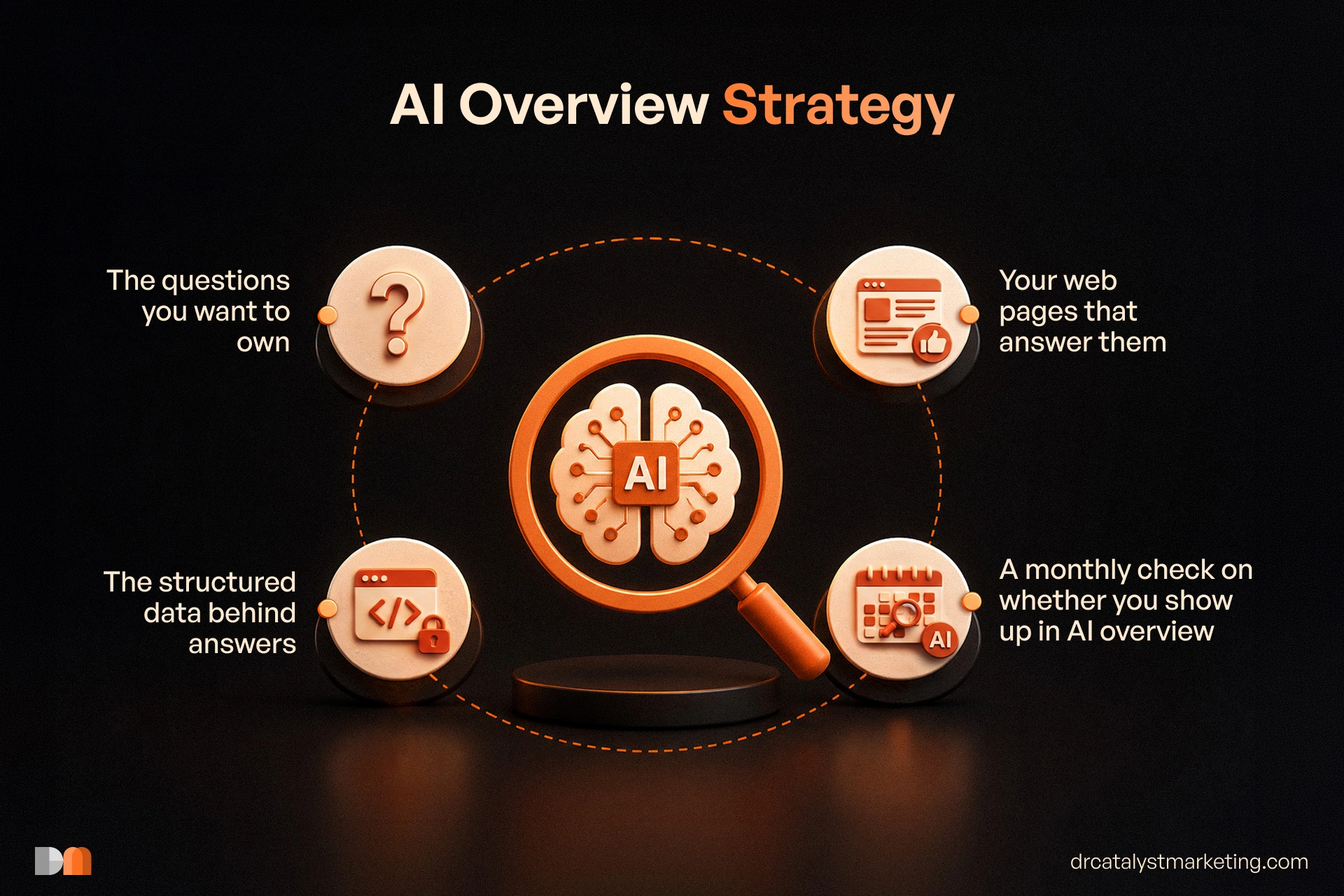
An AI Overviews Marketing Strategy fits on one page. The questions you want to own, the pages that answer them, the structured data behind those pages, and a monthly check on whether you actually show up sit behind the planning.
Almost nobody does the fourth one. A ranking drop turns up in your reports, whereas exclusion from a summary produces no signal at all, so you can lose ground for half a year without a number moving.
Practices being cited in AI Overviews today mostly come from pages that were already clear, well-structured, and properly sourced two years ago. For ordinary SEO reasons, it has nothing to do with AI. No shortcut gets you there retroactively. Start now, and you'll be in that position in eighteen months. At this point, much more of the buyer journey will sit inside this layer.
We have done healthcare marketing for twelve years across more than forty specialties. The questions patients ask a dermatologist look nothing like the ones they ask a fertility clinic, and Google assembles each summary from a different set of sources.
So far we have worked with more than 200 providers, from solo practices through to multi-location groups, and 95% of clients stay with us. The work spans patient acquisition, medical SEO and AEO, Google and Meta advertising, website design and conversion, content, video production, social media, reputation management and reporting.
Most of that reads like a fairly standard service list. What's worth pointing to is the order we do things in. We listen to how a practice actually runs before proposing anything. Our suggested plan built for a busy orthopedic group will not transfer to a two-provider clinic, and healthcare marketing has never been one-size-fits-all.
Patients research before they click, and a growing share now researches without clicking at all. Healthcare is further into that shift than almost any other industry. Roughly half of health searches return a summary before a single result appears below it.
The clinics doing well here are the ones a machine can summarize without getting anything wrong, and the ones patients already look up by name. None of it is clever. If you want to know where your practice sits in this layer right now, talk to our team.
Every specialty has its own patient journey. We know the difference between how someone searches for a fertility clinic and how they find urgent care.