Get a FREE marketing audit and discover what's holding your practice back from reaching its full potential.
At a beautiful time in your life, you must have opened a second office. Somewhere in the excitement, you also acquired a second Google listing, a new pile of reviews, and a new group of patients who have never heard of your first location. They’ve not heard about the first location because Google does not see one practice with two addresses. It sees two separate practices. Each one is ranked on its own, judged by its own reviews, and shown to a different set of people.
That matters because patients start their journey of looking for a treatment online. A study in Public Health Reports found that 74.9% of US adults went online first the last time they looked for health information. So if your original office has forty reviews and the new one has three, patients searching near the new one see three instead of the practice you spent years building. Marketing a multi-location medical practice is mostly about making each location strong on its own while keeping them recognizable as one practice. Everything below is how to do that.
Search engines are not being difficult on purpose. They are answering a question. When somebody types "dermatologist near me" at a red light, they do not want your corporate homepage. They want the office nine minutes away that can see them Thursday.
So each location gets judged on its own merits, such as address, reviews, page, and proximity to the person searching. Your excellent reputation in one suburb does almost nothing for you in the next one. This surprises a lot of physicians, because it is the opposite of how word of mouth works. Reputation travels between neighbors. Search rankings do not. Understanding this one quirk is most of what digital marketing for doctors actually comes down to.
The trick is holding two ideas at once under one brand with many neighborhoods. It is a balance to strike for! If you lean too far toward uniformity and every location page reads like a photocopy, it helps nobody and impresses no algorithm. But if you lean too far toward local independence and you end up with five clinics that look like five unrelated businesses, three logos, and a patient who genuinely cannot tell if they are in the right place.
A useful check for any multi-location medical practice is that if you swapped the city name on two of your location pages and nobody could tell the difference, then those pages are not doing their job.
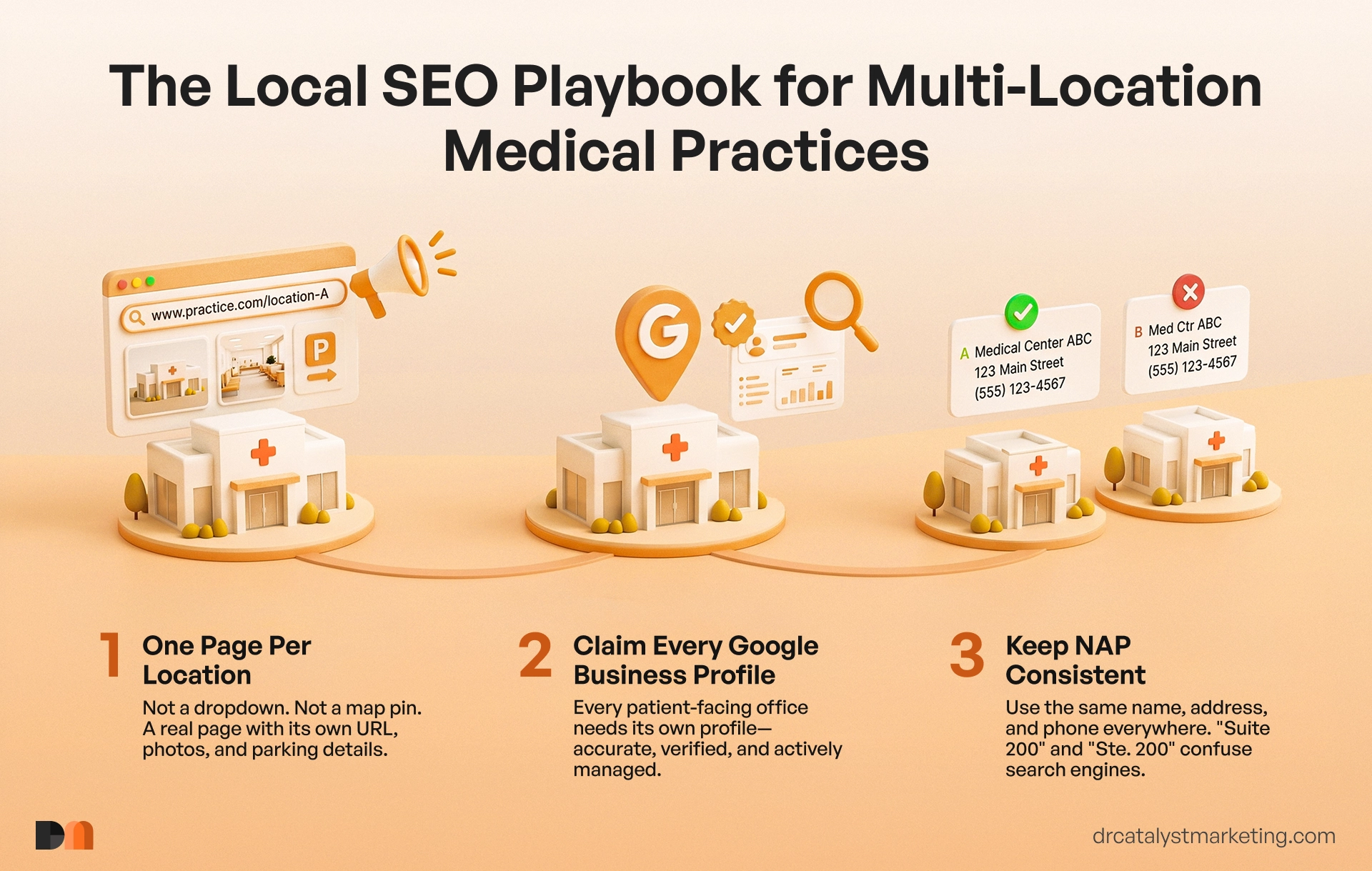
This is where most practices lose ground without noticing, because nothing looks broken. The website loads, and the phone rings. It just rings less than it should. Good SEO for multi-location medical practices mostly comes down to three habits.
This should not be a dropdown or simply a pin on a shared map. An actual page with its own web address, headline, photos of that building, and enough specific details. This will help an onlooking new patient know exactly where to park before visiting your clinic. A multi-location medical practice with six offices needs six pages. This is the single most common gap we find, and it is also the easiest to fix.
Every physical office where patients are consulted needs its own profile. Google publishes clear rules on how to represent a business with multiple locations, and healthcare needs to adhere to them for individual practitioner listings. In case of discrepancies, it can lead to duplicates, suspensions, or a listing pointing to a suite you vacated two years ago.
"Suite 200" in one place and "Ste. 200" in another. An old fax line on a health directory nobody has looked at since 2021. Collectively, this unupdated information makes search engines less confident about where you are. The confidence score is what rankings are made of. Any medical SEO agency will run this audit before touching anything else to build a strong SEO foundation for your healthcare practice.
There is one more reason this matters more than it did two years ago. Google's AI Overviews now answer a great number of health questions before anyone clicks anything. These AI-driven search queries turn up far less often once somebody attaches a place to the search. "Knee pain treatment" gets summarized and closed. "Knee specialist in Sacramento" still returns a list of practices.
Location-based searches are an opportunity, as these patients have completed their research and are shortlisting the clinics. They are far closer to picking up the phone than the person reading a summary about their symptoms at midnight. Our piece on AI search optimization covers the shift properly. For a multi-location medical practice, the takeaway is that local search is the corner of the results page that AI has disturbed least, and you happen to live there.
Nothing frustrates a practice owner faster than watching one location carry a 4.8 and another sit at 3.9, with the same staff standards, protocols, and leadership. But patients do not average your locations. They read the one nearest them and decide from there. However, response matters more than perfection. Experimental work published in the Journal of Medical Internet Research found that how a physician replies to a negative review measurably changes what prospective patients do with it. A thoughtful reply does not erase a one-star rating. It reframes the context.
Which means review collection cannot be a heroic effort by one enthusiastic front desk manager at one office. It has to be a system that runs at all of them. Building an online reputation management plan requires practices to acknowledge, take accountability, and act upon those reviews for patient satisfaction.
Everything so far takes time. Reviews accumulate slowly, rankings follow them, and a location that opened in March has neither. You can run an advertisement and put a new location in front of nearby patients the day it opens, before it has collected a single review. Your flagship office might be at capacity while the newest location has empty Tuesday afternoons and desperately needs the ad spend.
In case you use the ad budget spread evenly across every location, it is the marketing equivalent of prescribing the same dose to every patient regardless of weight. It is absolutely not right. Radius targeting solves most of this. Ads for the Northside clinic go to people near Northside, not to the whole metro area. It is also skipped constantly, and it is where a startling amount of healthcare ad money quietly evaporates. Worth remembering too that health advertising carries real compliance obligations, and the FTC's health products guidance is the starting point for what you can and cannot claim.
Then there is the part everyone is asking about. Yes, AI-driven lead generation genuinely helps a multi-location medical practice mostly by predicting which inquiries convert and routing them to the right office before they go cold. It is very fast pattern-matching applied to work alongside your front desk.
Growth stalls for a specific and fixable reason because nobody knows which location is actually working. Total new patients across the group is a comforting number, but it hides the office that is carrying everyone and the office that has been flat for four quarters.
Once you can see it, the decisions get easy. It can be a web page with thin content, or a profile nobody has updated, or a phone going to voicemail at 4:40 in the afternoon. If you cannot answer "which location brought in the most new patients last month," we can help you out.
We have spent over 12 years doing this across 40+ medical specialties, helping more than 200 providers grow, with a 95% client retention rate. That last number matters more than the others, because it means practices stay after the honeymoon phase ends.
For a multi-location medical practice, we build location pages that read like they belong to their neighborhoods, keep every Google Business Profile accurate, and manage the reputation at each office. Our Medical SEO services are built specifically for healthcare that acknowledges the path patients take to choose a doctor. Let’s find out which of your locations is underperforming and why.
Build reputation for each location. Keep the brand identical and the details local. Give every office a real page, a claimed profile, a consistent address, and a steady stream of reviews. Then measure it all separately, so the numbers tell you something you can act on. Do that consistently and a multi-location medical practice stops feeling like several businesses you are juggling.
Every specialty has its own patient journey. We know the difference between how someone searches for a fertility clinic and how they find urgent care.